- By Admin
- Floor
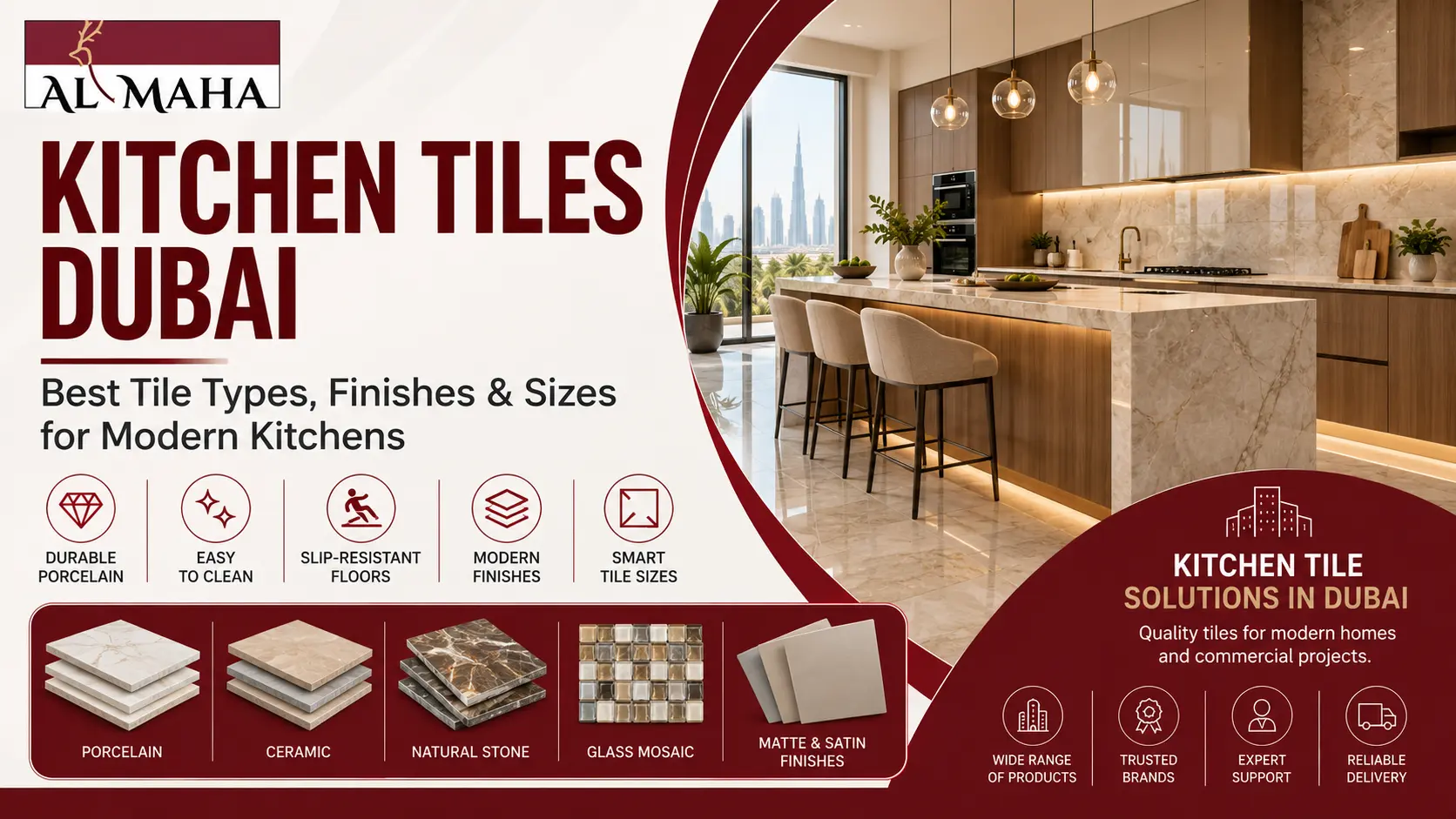
Kitchen Tiles Dubai: Best Tile Types, Finishes & Sizes for Modern Kitchens
Your kitchen takes more abuse than any other room in the house. Oil splatters, steam, spilled coffee, dropped pans and daily mopping all land on the same surfaces. In Dubai, you add humidity, AC condensation and strong sun on top.
The tiles you pick decide whether the kitchen still looks sharp in ten years or needs a redo in three. This guide covers the tile types, finishes, sizes, grout and budgets that work for kitchens in Dubai, so you can choose with confidence before you visit a showroom.
Why Dubai Kitchens Need a Different Tile Strategy
A kitchen in London and a kitchen in Dubai face different problems. Here is what makes local conditions tougher:
High humidity. Coastal moisture settles on cool surfaces and feeds mould in grout lines.
AC condensation. A cold, air-conditioned interior meets warm, humid air near kitchen doors and service yards. Water forms on tiles and slows drying.
Thermal shock. Floors near balconies or kitchen yards swing between cool interiors and very hot outdoor surfaces. Weak tiles and poor adhesive can crack.
Heavy cooking. Frying, tempering spices and long simmering put more grease and steam into the air than light cooking does.
Hard water. Mineral deposits leave white marks, especially on dark, glossy tiles.
Every choice below responds to one of these five issues.
The Best Tile Types for Dubai Kitchens
Porcelain: The Safe Default
Porcelain is the top pick for most kitchens here. It is fired at high temperatures, which makes it dense. Water absorption is very low, usually under 0.5%. That means it resists stains, moisture and mould better than most alternatives.
Why it works:
Handles heavy foot traffic and dropped cookware
Resists heat, grease and common household cleaners
Comes in marble, stone, concrete and wood looks
Works on floors, walls and splashbacks
If you want a deeper breakdown of how it compares with cheaper options, read our guide to porcelain tiles vs ceramic tiles in Dubai. You can also browse the full porcelain tile range or our overview of the best porcelain tiles.
Ceramic: Good for Walls on a Budget
Ceramic tiles are lighter and easier to cut. They cost less than porcelain. They suit kitchen walls and backsplashes, where impact and wear are low.
The trade-off is porosity. Ceramic absorbs more water and chips more easily. Use it on walls, not on a busy floor.
Natural Stone: Beautiful but Demanding
Marble, granite and travertine bring unmatched character. They also need sealing and regular care. Acidic spills such as lemon juice, vinegar and tomato can etch marble within minutes.
If you love the stone look, consider granite for countertops and splashbacks, or choose marble-look porcelain for the floor. Our comparison of marble vs granite in Dubai explains the differences, and you can see options in the marble and granite collection.
Glass and Glass Mosaic: Splashback Specialists
Glass is non-porous and wipes clean in seconds. It reflects light, which helps in compact kitchens. Use it on walls and splashbacks only. It is not built for floors.
Quick Comparison
Tile type | Best for | Durability | Maintenance | Moisture resistance |
Porcelain | Floors, walls, splashbacks | Very high | Low | Excellent |
Ceramic | Walls, backsplashes | Medium | Low | Good |
Natural stone | Counters, feature walls | High | High (sealing) | Fair to good |
Glass mosaic | Splashbacks | Medium | Very low | Excellent |
Tile Finishes: What Works in a Working Kitchen
Finish affects looks, cleaning effort and safety. Here is how each one behaves.
Glossy
Glossy tiles bounce light and make a kitchen feel brighter. Grease wipes off easily. The downside is visibility. Fingerprints, water spots and scratches show up fast. Gloss is best on walls, not floors.
Matte
Matte hides marks and feels calmer. It is the most popular choice for modern kitchens in Dubai. Cheaper matte tiles can trap grease in their surface texture, so pick a quality, tightly finished product.
Satin and Semi-Polished
Satin sits between the two. It has a soft sheen, shows fewer marks than gloss, and cleans more easily than rough matte. It works well on both floors and walls.
3D and Textured
Fluted, ribbed and relief tiles add depth to feature walls. They look striking behind a hob. They are also harder to clean, because oil settles in the grooves. Use them on a small accent area, away from the cooking zone.
Polished Porcelain
Polished porcelain has a mirror-like face. It looks luxurious and reflects light. It is also slippery when wet. For kitchen floors, avoid it or choose a lappato (semi-polished) alternative.
For a closer look at how each surface behaves, see our tile finish guide.
Slip Resistance: Check the R-Rating
Most guides skip this, but it matters. Kitchen floors get wet around the sink, dishwasher and fridge dispenser. Look for the R-rating, which measures slip resistance:
R9: Fine for dry areas only
R10: A good choice for most home kitchen floors
R11: Better for wet zones, kitchen yards and households with young children or older adults
Ask your supplier for the rating on every floor tile you consider. Do not guess from the look of the surface.
Kitchen Tile Sizes: Match the Tile to the Room
Tile size changes how a kitchen feels and how much cleaning it needs. Larger tiles mean fewer grout lines. Fewer grout lines mean less grease and mould to deal with.
Common Sizes and Where They Fit
Kitchen type | Recommended floor size | Recommended wall size | Why |
Closed galley kitchen | 60x60 cm or 60x120 cm | 30x60 cm or 10x30 cm | Keeps cuts clean in a narrow room |
Standard apartment kitchen | 60x60 cm or 60x120 cm | 30x60 cm, 7.5x30 cm | Balanced look, easy to install |
Open-plan villa kitchen | 80x80 cm, 60x120 cm or 120x120 cm | 60x120 cm | Continuous look, fewer joints |
Large luxury kitchen or island splashback | 120x240 cm slabs | 120x240 cm slabs | Seamless surface, minimal grout |
Tips for Choosing a Size
Small or galley kitchens: Stick to 60x60 cm or 60x120 cm. Giant slabs create awkward cuts and waste in tight spaces.
Open-plan villas: Go bigger. A 60x120 cm or 120x120 cm tile carries the floor from kitchen to living room without visual breaks.
Slabs: 120x240 cm porcelain slabs suit islands, full-height splashbacks and counters. They need experienced installers and careful handling.
Large sizes are popular, but they are not forgiving. The subfloor must be flat and the adhesive must be right. Read our guide to large-format porcelain tiles in Dubai and the breakdown of porcelain tile sizes before you commit.
Shapes and Layouts That Look Modern
Size is only half the story. The way you lay tiles shapes the whole look.
Subway (rectangular, offset): Timeless and cheap. Works behind the hob and sink.
Herringbone and chevron: Add movement to a splashback. They need more cutting, so labour costs rise.
Hexagonal: Great for a statement wall or a small floor area.
Kit-kat (slim vertical strips): A current trend that suits modern and Scandinavian styles.
Stacked straight lay: Clean, minimal and good for large rectangular tiles.
A simple rule helps: keep the floor calm and let the splashback carry the pattern. When both are busy, the kitchen feels crowded.
Grout: The Detail That Decides How Clean Your Kitchen Stays
Grout is where grease, steam and mould collect. It deserves the same attention as the tile.
Keep Joints Narrow
Rectified porcelain tiles have precise edges. You can lay them with joints of 2 mm or even less. Narrow joints give grease and moisture less room to settle. This is a big reason why 60x120 cm and larger formats are easier to maintain in heavy-cooking households.
Consider Epoxy Grout
Standard cement grout is porous. It absorbs oil, stains and moisture. Epoxy grout is non-porous, resists stains and does not need sealing. It costs more and takes skill to apply, but it makes sense in a busy kitchen, especially near the hob and sink.
Pick the Right Colour
Match the tile: Creates a seamless look and hides dirt.
Mid-grey or warm beige: Hides stains on most floors.
Avoid white on floors: It shows every mark within weeks.
Our porcelain tile grout guide covers joint widths and grout types in more detail.
How Much Do Kitchen Tiles Cost in Dubai?
Prices vary by brand, origin, size and thickness. The ranges below are indicative per square metre for the tile only. Confirm current prices with your supplier before you budget.
Tier | Approx. price per m² | What you get |
Budget | AED 40–80 | Basic ceramic and entry-level porcelain, standard sizes |
Mid-range | AED 80–200 | Good porcelain, large formats, wider design choice |
Premium | AED 200+ | Italian and Spanish porcelain, slabs, designer finishes |
Remember the other costs:
Labour: Installation rates rise for large formats, slabs and intricate patterns.
Adhesive and grout: Use the right products. Cheap adhesive causes expensive failures.
Waste: Order 10% extra for straight lays and 15% or more for diagonal or herringbone patterns.
Surface prep: Levelling an uneven floor adds cost but protects your investment.
A good tile on a bad subfloor will fail. A mid-range tile installed well will outlast a premium tile installed badly.
Installation Matters as Much as the Tile
Most cracked, hollow or lifting tiles come down to installation, not the tile itself. Before work starts, check these points:
Flat subfloor. Uneven floors cause lippage and cracks, especially with large tiles. See how to prepare the floor before installing porcelain tiles.
The right adhesive. Large, dense porcelain needs a quality polymer-modified adhesive. Our porcelain tile adhesive guide and the overview on how to choose tile adhesive in Dubai explain what to ask for. You can also see the tile glue range.
Movement joints. Heat expansion is real. Leave proper joints at walls and in large floor areas.
Full coverage. Back-butter large tiles so no hollow spots remain beneath them.
For the full process, read the porcelain tile installation guide for Dubai. If you want to avoid problems later, our article on how to prevent cracked porcelain tiles is worth a few minutes.
Keeping Kitchen Tiles Clean in a Humid Climate
Good maintenance is simple when the materials are right.
Wipe splashbacks daily with a damp cloth while grease is fresh.
Use pH-neutral cleaners on the floor. Harsh acids dull the finish and damage grout.
Ventilate. Run the extractor fan during and after cooking. Extraction keeps steam from settling on walls and grout.
Dry wet spots near the sink, especially during humid months.
Clean grout monthly with a soft brush and mild cleaner.
Reseal natural stone as recommended by your installer, usually once a year.
If mould keeps returning, the cause is usually poor ventilation or porous grout, not the tile.
Common Kitchen Tile Mistakes to Avoid
Choosing polished tiles for the floor. Beautiful in the showroom, risky near the sink.
Ignoring the R-rating. Always check slip resistance.
Using wide grout lines with large tiles. They look uneven and catch grease.
Buying tiles before checking the batch. Shade differences between batches are visible. Order everything at once, plus extra.
Skipping the subfloor check. This is the most expensive shortcut.
Picking a supplier on price alone. Quality, stock consistency and after-sales support matter. Our guide on how to choose the best tile supplier in Dubai shows what to look for.
A Simple Formula for a Modern Dubai Kitchen
If you want a starting point, this combination works for most homes:
Floor: 60x120 cm matte or satin porcelain, R10 rating, 2 mm joints, dark-tone grout matched to the tile
Walls and splashback: Glossy or satin porcelain in a large rectangular format, or a ceramic subway for a lower budget
Accent: One feature area in textured or patterned tile, kept away from the hob
Counter or island: Granite, quartz or porcelain slab
Grout: Epoxy near the hob and sink
Adjust the sizes for your layout and budget. The principle stays the same: dense material, low-porosity grout, minimal joints and a safe floor surface.
Frequently Asked Questions
What is the best tile for a kitchen floor in Dubai?
Matte or satin porcelain with an R10 or R11 slip rating. It is dense, easy to clean and handles heat and humidity well.
Are large-format tiles good for kitchens?
Yes, especially in open-plan kitchens. They reduce grout lines, which means less cleaning. They do need a flat subfloor and skilled installation.
Is glossy or matte better for a kitchen?
Glossy works well on walls for easy wiping. Matte or satin is better on floors because it hides marks and grips better.
Do I need epoxy grout?
Not everywhere, but it is worth it near the hob and sink. It resists stains and moisture far better than cement grout.
How much extra tile should I order?
Order 10% extra for simple layouts and 15% or more for diagonal and herringbone patterns.
Ready to Choose Your Kitchen Tiles?
The right kitchen tile balances looks, safety and easy upkeep. Start with porcelain, choose a finish that suits how you cook, match the size to your layout and don't overlook the grout.
Want to compare options in person? Browse the full tile categories, read our tile buying guide for Dubai, or contact the Maha team to discuss your kitchen project and get a quote.
 20 Oct, 2026